You have spent a year on grammar. Tonight we begin the second art: logic.

The Art of Logic · Part 1 · Words and terms · B2
The Three Arts: What Logic Is For
Part 1 of The Art of Logic: grammar, logic and rhetoric are three arts of one language. A sentence can be perfectly correct, perfectly persuasive, and still perfectly unreasonable. Logic is the art that notices. Describing what something does (is concerned with, deals with, aims to, enables us to), with Philo, Sophia, Marcos and Demetria.

SOPHIA
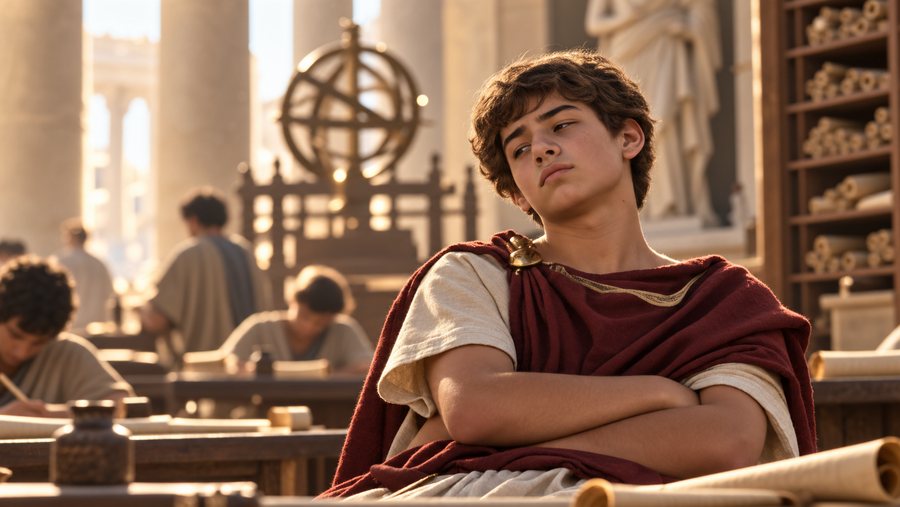
MARCOS
Is it harder than grammar?
SOPHIA
Different. Grammar asks whether a sentence is well made. Logic asks whether a thought follows from another thought.

DEMETRIA
And the third art?
SOPHIA
Rhetoric asks whether you can make someone else see it. Three arts, one language.
Before you read
Greece, Rome and, much later, Indiana
The Greeks and Romans taught a set of liberal arts, the skills of a free person. Things to come: in the Middle Ages, the first three, grammar, logic (also called dialectic) and rhetoric, will be called the trivium, “the three roads”, and the other four, arithmetic, geometry, music and astronomy, the quadrivium.
Aristotle had already written the first systematic books on logic, later collected as the Organon, “the instrument”: logic was a tool for all the other sciences. The Stoics added their own logic of “if” and “or”.
Things to come: in 1937, an American teacher, Sister Miriam Joseph, will publish The Trivium, a book that teaches the three arts as one. For her, grammar is concerned with symbols and how they combine; logic deals with thinking, and aims at truth; rhetoric is concerned with communicating a thought to another mind. Our logic lessons follow the order of her book.
Correct, true and persuasive are three different things.
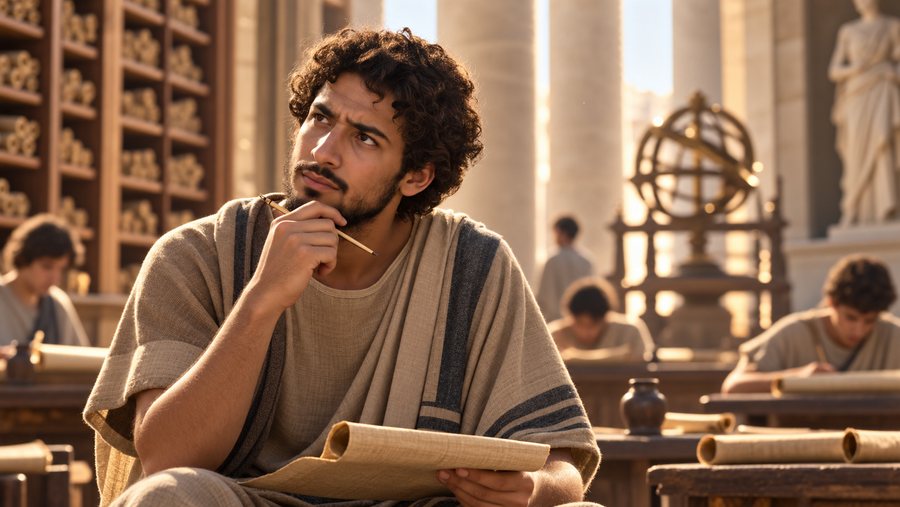
PHILO
Read the story. Was Marcos’s sentence correct? Was his argument logical? Did it persuade the crowd?
SOPHIA
Then answer Section A.
The story
A story for this lesson.
Something had been stealing fish from the Library kitchen. Marcos stood on a bench in the courtyard and spoke to the crowd of cooks and scribes. “Every thief comes at night,” he said, in perfect Greek. “The scholar’s cat comes at night. Therefore the scholar’s cat is the thief!” The cooks cheered, and one of them went to find a stick.
Demetria put up her hand. “Your grammar was beautiful,” she said, “and your speech was very persuasive. But your reasoning is broken. Owls come at night. The night watchman comes at night. Are they thieves too? You have shown that the thief and the cat share one quality. You have not shown that the cat is the thief.”
The cook put down his stick. Philo laughed. “Three arts in one argument,” he said. “Marcos was correct, which is grammar. He was convincing, which is rhetoric. He was wrong, which is logic.” Two nights later, the real thief was caught: a seagull that came in through the kitchen roof, in broad daylight.
Is concerned with, deals with
MARCOS
Grammar is concerned with how words combine. Logic deals with reasoning. Rhetoric is about persuading others.
SOPHIA
be concerned with / deal with / be about + noun or -ing: describing the subject or field of something. In academic English: Logic is concerned with the relations between propositions.
Aims to, enables us to
DEMETRIA
Logic aims to find the truth. It enables us to test an argument. It allows us to see where reasoning goes wrong. It helps us think clearly.
SOPHIA
aim to + infinitive (purpose); enable / allow + object + to-infinitive (what it makes possible); help + object + (to) infinitive.
Words of the three arts
PHILO
Grammar studies symbols. Logic studies reasoning and inference: getting from what we know to what follows. An argument is valid if its conclusion follows; it is sound if it is also true. Rhetoric studies persuasion.
SOPHIA
Words: trivium, liberal arts, grammar, logic, rhetoric, reasoning, inference, argument, premise, conclusion, valid, sound, persuade.
Sophia’s check: correct, valid, persuasive?
| Sentence | Label | Why |
|---|---|---|
| Every thief comes at night; the cat comes at night; so the cat is the thief. | Invalid | Sharing one quality does not make two things the same. |
| Every fish in this basket is fresh; this fish is in the basket; so it is fresh. | Valid | If the premises are true, the conclusion must be. |
| The cat steal the fish yesterday. | Ungrammatical | A grammar mistake, not a logic mistake: stole. |
| “Friends, would a creature of the night ever be innocent?” | Rhetoric | A rhetorical question: it persuades, but proves nothing. |
| A valid argument always has a true conclusion. | False | Only if the premises are true: then it is sound. |
Sophia’s comparison: the debaters of China
SOPHIA
Far to the east, the followers of Mozi studied argument too. They called it bian, disputation: deciding which of two claims is right. They wrote rules for when a comparison really proves something, and warned that two things alike in one way are not alike in every way.
DEMETRIA
Exactly Marcos’s mistake!
SOPHIA
Exactly. Greeks and Chinese, who never met, both discovered that people are persuaded by bad arguments, and both tried to write rules to stop it.
PHILO
Then logic is not Greek, or Chinese. It is human. That makes me want to learn it even more.
Sophia’s summary
| Words and forms | Use | Example |
|---|---|---|
| be concerned with / deal with + noun | the subject of something | Logic deals with reasoning. |
| be about + noun / -ing | informal | Rhetoric is about persuading people. |
| aim to + infinitive | purpose | Logic aims to find the truth. |
| enable / allow + object + to | what it makes possible | It enables us to test an argument. |
| valid / sound | logic | A sound argument is valid and true. |
| premise, conclusion, inference | parts of an argument | The conclusion follows from the premises. |
Practice
Read the story for Section A, then do the rest. Press “Check my answers” at the end. You can try again as many times as you like.
A · The story
Read the story and choose the best answer.
1. What does the trivium consist of?
2. What did Aristotle’s logic books come to be called?
3. Was Marcos’s sentence grammatically correct?
4. What was wrong with his argument?
5. Who was the real thief?
6. What did the Mohists call disputation?
B · Grammar and vocabulary
Write the missing word or words.
7. Logic is concerned reasoning.
8. Rhetoric deals persuasion.
9. Logic aims find the truth.
10. It enables us test an argument.
11. A argument is one whose conclusion follows from its premises.
12. An argument that is valid and true is .
C · Right or wrong?
Is the sentence correct English?
13. “Logic is concerned about reasoning.”
14. “Grammar deals with symbols and how they combine.”
15. “Logic enables to test an argument.”
16. “Rhetoric aims to persuade.”
Talk and write
Discussion and writing
Correct, valid, persuasive. In groups, write one argument that is grammatical and persuasive but invalid, like Marcos’s. Swap with another group and find the flaw.
Discuss. 1. Why are people persuaded by bad arguments? 2. Which matters more: being right or being convincing? 3. Where do you meet bad arguments every day?
Write (120–150 words). Three arts. Explain what grammar, logic and rhetoric each deal with, using is concerned with, deals with, aims to and enables us to.