We have told many myths together: gods, giants, heroes and monsters. Tonight we begin something different: the people who tried to find out what really happened. Not what the poets sang, but what witnesses saw.

Ancient Historians · Part 1 · The beginning of history · B1
What Is History?
Part 1 of Ancient Historians: before there were historians, there were myths, epic poems, king lists and temple records. Then, in the Greek cities of Ionia, a few writers began to ask questions: who saw this, who told you, and how do you know? The Greek word for that questioning was historia, “inquiry”. The past simple and the present perfect for history (Herodotus wrote…; historians have argued…), according to, and the language of sources and evidence, with Philo, Sophia, Marcos and Demetria.
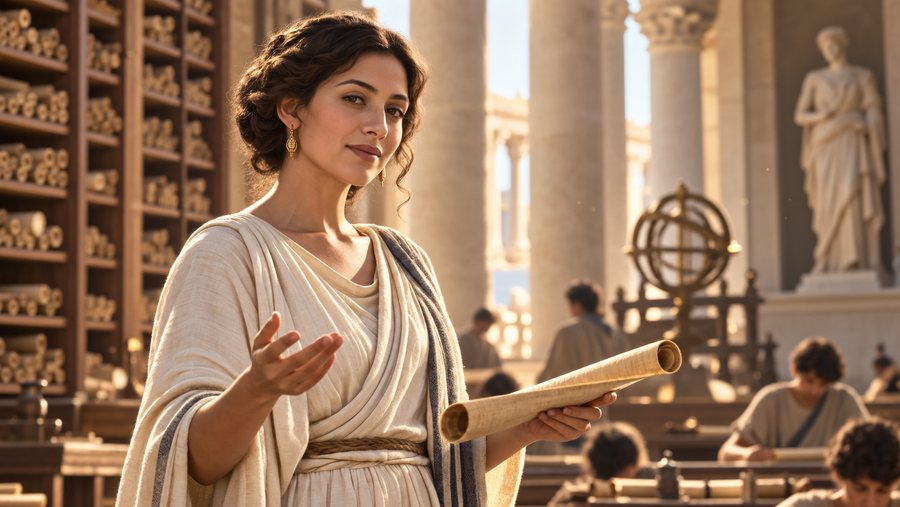
SOPHIA
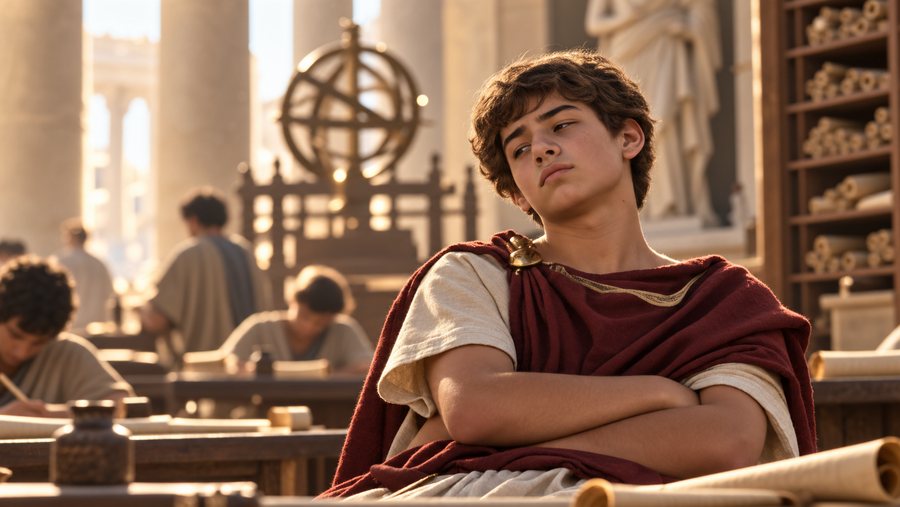
MARCOS
Isn’t that the same thing?
SOPHIA
That is exactly the question they asked, Marcos. Homer sang about Troy, but was he there? Who told him? The first historians said: let’s not just repeat the stories. Let’s ask questions. Their word for asking questions was historia. Tonight you’ll learn how to talk about the past, and about the people who write about it.
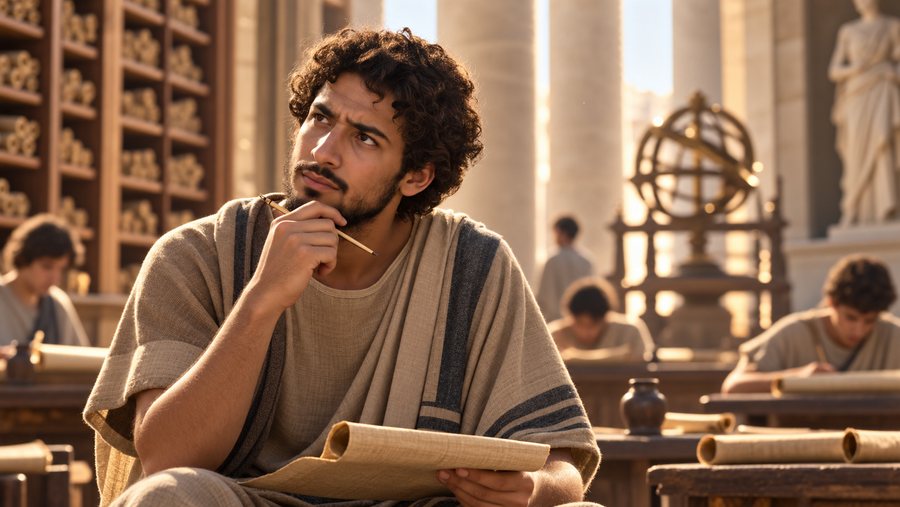
PHILO
Our scriptures have their own histories, and their own questions about how they were written. I’m curious to compare.
Read: the inquiry
Before you read
The Greek cities of Ionia, about 550–400 BCE
Long before the Greeks wrote history, other peoples kept records of the past. Egyptian priests and Babylonian scribes wrote king lists and annals, year by year; the Hebrew scriptures contain the books of Kings and Chronicles; and the Greeks had epic poems like Homer’s Iliad, about heroes and gods, sung by poets who said the Muses had told them the truth.
In the 6th century BCE, in the rich Greek cities of Ionia on the coast of what is now Turkey, a few writers began to write about the past in prose, not poetry, and to ask how we can know it. The Greek word historia meant “inquiry”, finding out by asking questions. Herodotus begins his book: “This is the display of the inquiry of Herodotus of Halicarnassus, so that the deeds of men are not forgotten in time.” He is often called the “father of history”.
Historians learned to ask three kinds of question. What did I see myself (eyewitness)? What did others tell me (hearsay), and can I trust them? And what is most likely, using my own judgement? They also learned to admit when they did not know, and to report different versions. These are still the basic tools of every historian and every good journalist today: check your sources, compare accounts, and tell your reader how sure you are.
The past is not simply remembered; it is found out.
PHILO
Read the story. What kinds of records existed before the Greek historians? What does historia mean? What three questions did historians learn to ask?
SOPHIA
Then answer Section A.
The story
Retold for this lesson from the opening chapters of Herodotus and Thucydides.
For hundreds of years, if a Greek wanted to know about the past, he listened to a poet. The poet would sit by the fire with his lyre and sing of Achilles and Hector, of Odysseus and the Cyclops, and when the audience asked how he knew, he would say: “The Muse told me. The Muses are the daughters of Memory; they were there, and they know everything.” Nobody asked how many ships really sailed to Troy, or whether the Cyclops really had one eye. The stories were beautiful and old, and that was enough.
But in the 6th century BCE, in the busy harbour cities of Ionia, where Greek merchants traded with Egyptians, Phoenicians, Lydians and Persians, people began to notice something. Every people had different stories about the past, and they could not all be true. A Greek traveller in Egypt might hear an Egyptian priest say that his city was ten thousand years old, and that the Greeks were like children who knew nothing. Some Ionian thinkers began to write in plain prose, not poetry, about geography, family trees and the past, and to compare what different peoples said.
One of them, a man from Halicarnassus called Herodotus, spent years travelling: to Egypt, to Babylon perhaps, to the Black Sea, to Italy. Everywhere he went, he asked questions. What happened here? Who told you? Did you see it yourself? When people gave him different answers, he wrote them all down, and sometimes added: “I am obliged to report what is said, but I am not obliged to believe it.” He called his book an historia, an inquiry, and he began it with his own name, not with a prayer to the Muse.
A generation later, an Athenian called Thucydides went further. He said that he would only write about events he had seen himself, or had checked carefully with eyewitnesses, because “different eyewitnesses give different accounts of the same events, depending on their memory or their sympathies.” He wanted his history to be, he said, “a possession for all time”. And so history was born: not as a song from the Muses, but as a set of questions that every reader can ask. Who saw it? Who told you? And how do you know?
The past simple for finished history
MARCOS
Herodotus wrote his book about 430 BCE. He travelled to Egypt. The Persians invaded Greece in 480 BCE. The first historians lived in Ionia.
SOPHIA
past simple for events and lives that are finished, often with a date or time: in 480 BCE, about 430 BCE, two thousand years ago.
The present perfect for the story of history
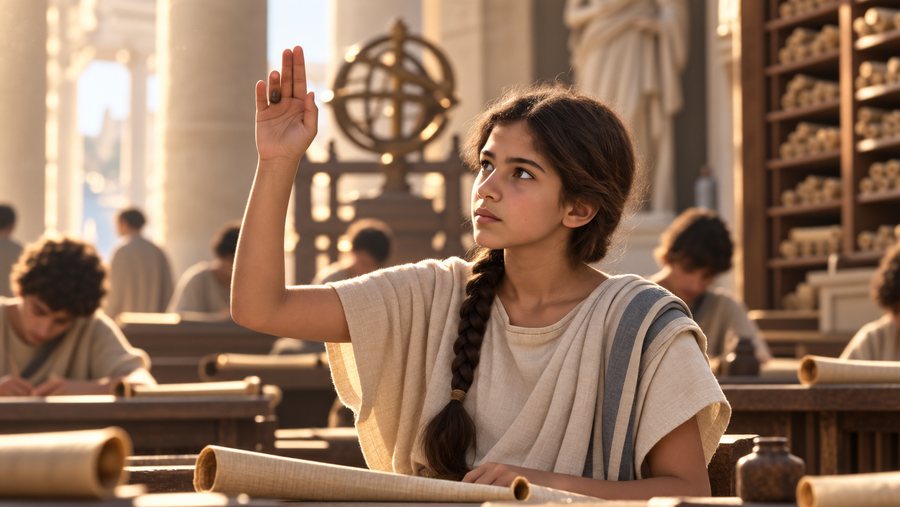
DEMETRIA
Historians have argued about Herodotus for centuries. People have called him the father of history. Archaeologists have found new evidence. Have you ever read a history book?
SOPHIA
present perfect for things that connect the past to now, with no finished time: for centuries, ever, never, recently, so far. Compare: Herodotus wrote (finished) / Historians have studied him (up to now).
According to, and the language of sources
PHILO
According to Herodotus, the Egyptians were the oldest people. A source is where information comes from. An eyewitness saw it; hearsay is what others say. A reliable source can be trusted; a biased one takes sides.
SOPHIA
according to + person / source (never according to me: say in my opinion). Words: a source, evidence, an eyewitness, hearsay, reliable, unreliable, biased, an account, a version, a record, to inquire.
Sophia’s comparison: Clio, and the Chronicles of the Kings
SOPHIA
We Greeks give history her own Muse: Clio, who holds a scroll. But notice: Herodotus does not begin “Sing, Muse”, like Homer. He begins with his own name. The historian takes responsibility for what he says.
PHILO
Our books of Kings often say: “The rest of his deeds, are they not written in the Book of the Chronicles of the Kings of Judah?” Our writers, too, used older sources and pointed their readers to them. And scholars today ask the same questions of our books that Herodotus asked of his: who wrote them, when, and from which sources.
Sophia’s summary
| Words and forms | Use | Example |
|---|---|---|
| wrote / travelled / invaded | past simple for finished history | Herodotus wrote his book about 430 BCE. |
| have argued / have found | present perfect: past to now | Historians have argued about him for centuries. |
| according to + source | reporting a source | According to Herodotus, … |
| eyewitness, hearsay, source, biased | sources and evidence | An eyewitness saw it. |
| historia = inquiry | the meaning of history | Historia means finding out by asking. |
Practice
Read the story for Section A, then do the rest. Press “Check my answers” at the end. You can try again as many times as you like.
A · The story
Read the story and choose the best answer.
1. What does the Greek word historia mean?
2. Where did the first Greek historians live?
3. Who is often called the “father of history”?
4. What is an eyewitness?
5. What is hearsay?
6. Which of these existed before Greek history?
B · Grammar and vocabulary
Write the missing word or words.
7. Herodotus his book about 430 BCE. (write)
8. Historians have about him for centuries. (argue)
9. to Herodotus, the Egyptians were very old.
10. you ever read a history book?
11. A person who saw an event is an .
12. A source takes sides. (one-sided)
C · Right or wrong?
Is the sentence correct English?
13. “Herodotus has written his book in 430 BCE.”
14. “Historians have studied him for centuries.”
15. “According to me, history is interesting.”
16. “According to Herodotus, the war began in Lydia.”
Talk and write
Discussion and writing
Be a historian. In groups, investigate a small event in your school or family: who saw it, who heard about it, and what different versions exist? Report it using according to and the past simple.
Discuss. 1. What is the difference between a myth and history? 2. Why does it matter whether a writer was an eyewitness? 3. Where do you get your news from, and how do you know it is reliable?
Write (100–120 words). An inquiry. Write about something that happened in your town, explaining your sources, using the past simple, the present perfect and according to.