We have told the myths of the Near East together, and stories from Philo’s scrolls. Now we begin something harder: the history of the lands between the Nile and the Tigris. Not what the stories say, but what we can show.

History of the Ancient Near East · Part 1 · How we know · B1
How We Know
Part 1 of History of the Ancient Near East: before we tell the story of Sumer, Egypt, Assyria, Israel, Babylon and Persia, we ask how anyone can know it. Clay tablets, stone inscriptions, layers of earth, and later books like Herodotus and the Hebrew Bible, with one rule for all of them. The past passive (was found, was written), certainly, probably and possibly, and the language of evidence: what scholars agree on, what they debate, and what nobody knows, with Philo, Sophia, Marcos and Demetria.
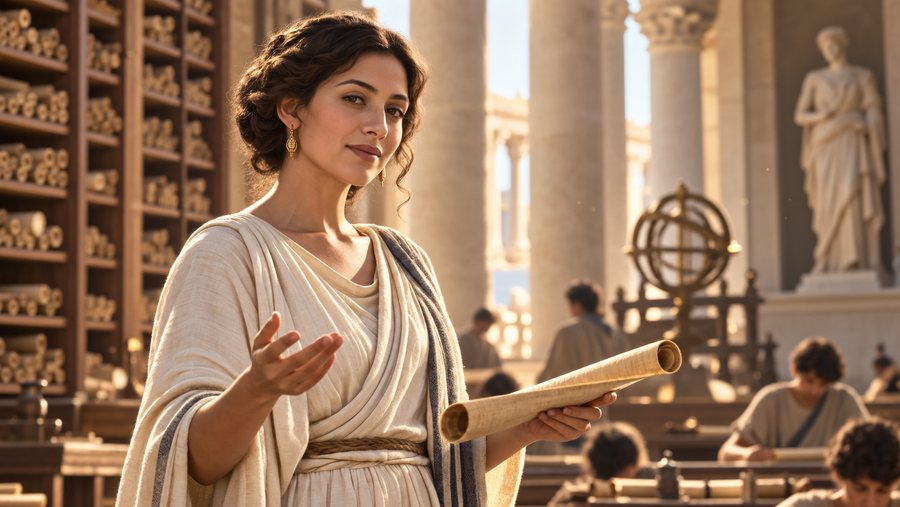
SOPHIA
DEMETRIA
And how can anyone show anything? Those kingdoms are older than Homer.
SOPHIA
With three kinds of evidence, and one rule. The rule is this: every people’s books get the same questions. Babylonian, Egyptian, Greek, and Philo’s own.
PHILO
That is fair. I believe our scriptures are holy, but an honest question cannot hurt a true book. Ask away, Sophia.
Read: three kinds of evidence
Before you read
The ancient Near East, about 3500 BCE to 1 CE
The ancient Near East means the lands of Mesopotamia (modern Iraq, and parts of Syria and Turkey), the Levant (modern Syria, Lebanon, Israel, Palestine and Jordan), Egypt, Anatolia and Iran. Writing was invented here, in Mesopotamia and in Egypt, a little before 3000 BCE, so this is where written history begins.
Historians use three kinds of evidence. First, texts written at the time: clay tablets in cuneiform, Egyptian hieroglyphs, stone inscriptions, letters, contracts and king lists. Second, archaeology: the remains of cities, houses, pottery, tools, bones and seeds. Many ancient towns are now a tell, a hill made of the layers of older towns, one on top of another. Third, later writings, such as Herodotus, the Babylonian priest Berossus, the Egyptian priest Manetho, and the Hebrew Bible, which were written down long after many of the events they describe.
Each kind of evidence has problems. Kings’ inscriptions boast, and almost never mention a defeat. Archaeology finds pots, not names. Later writers used older sources, but also legends, and they wrote for their own purposes. So historians ask the same questions of every text: who wrote it, when, why, and can it be checked against other evidence? In this series, we label each claim: consensus (most scholars agree), debated (serious scholars disagree), or unknown (we do not have the evidence).
One rule for every people’s books.
PHILO
Read the story. What three kinds of evidence do historians use? What is a tell? What do the Assyrian prism and the book of Kings agree about?
SOPHIA
Then answer Section A.
The story
Retold for this lesson. The garden and the tablet are imagined; the history is real.
One spring morning, Sophia asked Marcos to plant a fig tree in the Library garden. He dug for an hour, complaining, and then stopped. Near the top of the hole there was a broken clay lamp, the kind sold in every market in Alexandria. A little deeper there was a coin with the head of one of the old Ptolemies. And at the bottom, in hard grey earth, there was a small blue amulet in the old Egyptian style. “Rubbish,” said Marcos. “Evidence,” said Sophia. “The deeper it is, the older it is, unless somebody dug a pit. You have just read three hundred years of this garden without a single book.”
Then Demetria arrived with a present: a small clay tablet that a trader from Babylon had sold her. It was covered in tiny wedge-shaped marks. Nobody in Alexandria could read it. “In Babylon,” said Sophia, “a few temple astronomers still write like this. Soon there will be none. The tablets will sleep in the ground for nearly two thousand years, and whole kingdoms will be forgotten.” She smiled. “But that is a story for later. Things to come.”
Philo had brought the scroll of Kings. He read how the Assyrian king Sennacherib attacked Judah, how King Hezekiah paid him thirty talents of gold, and how Jerusalem was saved, because the angel of the Lord struck the Assyrian camp. Sophia listened. “Here is a thing to come,” she said. “One day, a six-sided clay prism will be dug up from the ruins of Nineveh, his capital. It tells the same war from the other side. Sennacherib boasts that he took forty-six cities of Judah and shut Hezekiah up in Jerusalem ‘like a bird in a cage’. He also says thirty talents of gold.”
“And the angel?” asked Philo. “The prism does not mention it,” said Sophia, “and it does not say that Sennacherib took Jerusalem, either. A king who boasts about everything does not boast about that. So a historian can say: on this, two enemies agree. Jerusalem was not taken, and Hezekiah paid. Why the Assyrians went home, the two sources disagree, and nothing else tells us.” Philo rolled up his scroll slowly. “Two witnesses,” he said, “who hate each other. When they agree, it is worth listening.”
The past passive for finds and texts
MARCOS
The lamp was found near the top. The tablet was written in cuneiform. Writing was invented in Mesopotamia. The prism was discovered at Nineveh.
SOPHIA
was / were + past participle when the thing is more important than the person who did it, or when we do not know who did it. Add by if you need the person: The tablet was written by a scribe.
Certainly, probably, possibly
DEMETRIA
The lamp is certainly Roman. The coin is probably older than the lamp. The amulet was possibly brought from Upper Egypt.
SOPHIA
certainly (we are sure), probably (it is likely), possibly / perhaps (it may be true). Put the adverb after be and before the main verb: It is probably old. It was probably written in Babylon.
Consensus, debated, unknown
PHILO
Most scholars agree that writing was invented in Mesopotamia. Scholars disagree about why Sennacherib went home. Nobody knows who first wrote the oldest king lists.
SOPHIA
Consensus: most scholars agree that…, there is a consensus that… Debated: scholars disagree about…, it is debated whether… Unknown: nobody knows…, there is no evidence for… We will use these three labels in every lesson.
Sophia’s evidence check
| Claim | Label | Why |
|---|---|---|
| Writing was invented in Mesopotamia before 3000 BCE. | Consensus | Thousands of early clay tablets have been found at Uruk. |
| Egyptian writing began at about the same time, without copying Mesopotamia. | Debated | Early Egyptian labels are very old; scholars argue about whether the idea travelled. |
| Sennacherib did not capture Jerusalem in 701 BCE. | Consensus | The Assyrian prism and the book of Kings agree. |
| Why Sennacherib went home. | Debated | The two sources disagree, and no third source tells us. |
Sophia’s comparison: two enemies agree
PHILO
I read the first chapters of Moses as allegory: the garden and the serpent are pictures of the soul. So I can hardly complain if you read some of our stories as something other than plain history. I ask only one thing: be as fair to us as to the Babylonians.
SOPHIA
That is the rule, and it works in every direction. A boasting Assyrian king is not believed blindly; neither is Herodotus, and neither is the book of Kings. And where they agree, we are standing on firmer ground.
SOPHIA
One more warning, Philo. Your scrolls loom large for us because they survived and became famous. At the time, Judah was a small hill kingdom. Herodotus, who wrote about almost every people he had heard of, never even names the Jews.
PHILO
That is humbling, and probably good for me. Then let us look at the giants of the old world on their own terms, and see where my small people fits in afterwards.
Sophia’s summary
| Words and forms | Use | Example |
|---|---|---|
| was found / were written | past passive | The prism was found at Nineveh. |
| certainly, probably, possibly | how sure we are | It was probably written in Babylon. |
| most scholars agree that | consensus | Most scholars agree that writing began in Mesopotamia. |
| scholars disagree about / it is debated whether | debated | Scholars disagree about why he went home. |
| nobody knows / there is no evidence for | unknown | Nobody knows who wrote it. |
| tell, inscription, tablet, source | the language of evidence | A tell is a hill of old towns. |
Practice
Read the story for Section A, then do the rest. Press “Check my answers” at the end. You can try again as many times as you like.
A · The story
Read the story and choose the best answer.
1. What is a tell?
2. Where was writing first invented?
3. Which object in Marcos’s hole was the oldest?
4. Why don’t historians simply believe kings’ inscriptions?
5. What do the Assyrian prism and the book of Kings agree about?
6. In this series, what does “debated” mean?
B · Grammar and vocabulary
Write the missing word or words.
7. The tablet written in cuneiform. (be)
8. The prism was at Nineveh. (find)
9. Writing invented in Mesopotamia.
10. The coin is older than the lamp. (likely)
11. Most scholars that writing began in Mesopotamia.
12. Nobody who wrote the first king list. (know)
C · Right or wrong?
Is the sentence correct English?
13. “The tablet was wrote by a scribe.”
14. “The coins were found in the lower layer.”
15. “Scholars are disagree about the date.”
16. “It was probably written in Babylon.”
Talk and write
Discussion and writing
Be an archaeologist. Look at a drawer, a bag or a rubbish bin. What is at the bottom, and what is at the top? What does that tell you about the order of events? Report it with the past passive and probably.
Discuss. 1. Why should every people’s texts get the same questions? 2. Can a source be biased and still useful? 3. What is the difference between “there is no evidence” and “it did not happen”?
Write (100–120 words). Two sources. Choose something that two people in your family remember differently. What do they agree on? What do they disagree about? Use was / were + past participle, probably, and they agree that… / they disagree about…