Past only tells you when. It doesn't tell you how.

An Incident with a Shelf
What happened, and what was happening — past simple and past continuous, taught by Sophia, tested against an accident, and precisely footnoted by Philo.

SOPHIA

MARCOS
It happened, or it didn't. How many ways can there be?
SOPHIA
Two — and neither is about when. One shows you the whole action, finished. The other catches you inside it, still going.

PHILO
So the tense is fixed. It's the aspect that moves.

THE CLERK
"While I was carrying the basket back to the shelf..."
MARCOS
"...the shelf gave way."
SOPHIA
There. One verb sets the scene, unfinished. The other cuts across it, complete. That's the whole pattern: "while" for the background, past simple for what interrupts it.

DEMETRIA
So the shelf didn't "give way" slowly. It just — happened.
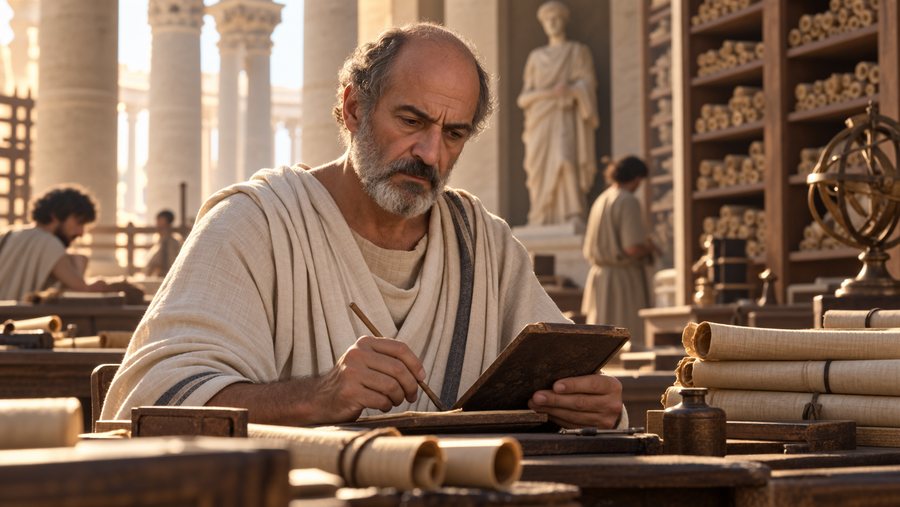
THE SCHOLAR
"While the clerk was carrying the basket, I was already writing my report of it."
SOPHIA
Neither of those needs the other to finish first. Two actions, both unfinished, both running at once. Continuous doesn't need an interruption — it only needs to still be going.
DEMETRIA
Marcos used to trip over that basket every week.
MARCOS
Used to? So I've stopped? That's not the same as saying "I tripped."
SOPHIA
No. A single complete event is past simple. A habit — repeated, and now finished — takes "used to." It goes with how often — every week, always — but never with one moment or a number of times: not "used to trip yesterday," not "used to trip three times."
PHILO
A photograph, a film still running, and a pattern that held for a while and then stopped.
PHILO
Hebrew makes this almost plainer than we do. Its verbs barely ask when at all — they ask only whether the action is complete or still unfolding. Aspect first; time, if you need it, comes from context.
SOPHIA
Which is exactly what I've been asking you to hear under the English.
MARCOS
So it's official. The shelf's fall was complete. My blame is ongoing.
SOPHIA
Now you've got it.