Yesterday you learned that grammar only cares what job a word does. Today you learn the list of jobs. There are eight, and every word you'll ever meet holds exactly one of them — in any given sentence.

What Words Do
The complete list Sophia promised — noun, pronoun, verb, adjective, adverb, preposition, conjunction, and interjection — every job a word is allowed to hold, taught by Sophia, resisted by Marcos, tested by whoever happens to walk past, and precisely footnoted by Philo.

SOPHIA

MARCOS
Only eight? That seems too small a number for a language this troublesome.
Noun

PHILO
A noun names something — a person, a place, a thing, or an idea that has no shape at all. Library. Sophia. Wisdom. Each one names, and naming is the whole of its job.
SOPHIA
The oldest job of all. Before anyone could say anything about the world, they first had to name the pieces of it.
Pronoun

DEMETRIA
"Sophia teaches. Sophia argues. Sophia never stops." Must I say her name every time?
SOPHIA
Never — that's precisely what a pronoun is for. She stands in the noun's place once the noun has already been introduced, so the sentence doesn't have to keep repeating itself.
Verb

THE CLERK
I carry the baskets. I catalogue the scrolls. By midday I am exhausted.
SOPHIA
A verb names an action, or a state of being — carrying, cataloguing, or simply being exhausted. Nothing happens in a sentence, and nothing merely is, without one.
Adjective
MARCOS
"Scroll" tells me nothing. "The ancient, brittle scroll" tells me to carry it very carefully.
PHILO
An adjective describes a noun — narrows it, colours it, warns you about it. You've just proven, by accident, that you were listening.
Adverb
SOPHIA
And how did he carry it, once you'd warned him?
MARCOS
Carefully. An adverb — it describes the verb, the way the adjective described the noun. I did learn something yesterday, apparently.
Preposition
DEMETRIA
Is it on the shelf, under the shelf, or behind the shelf? Because those are three very different afternoons for whoever has to find it.
SOPHIA
A preposition places one thing in relation to another — where, or when, or how something stands beside something else. Small words, and yet they decide whether you find the scroll at all.
Conjunction
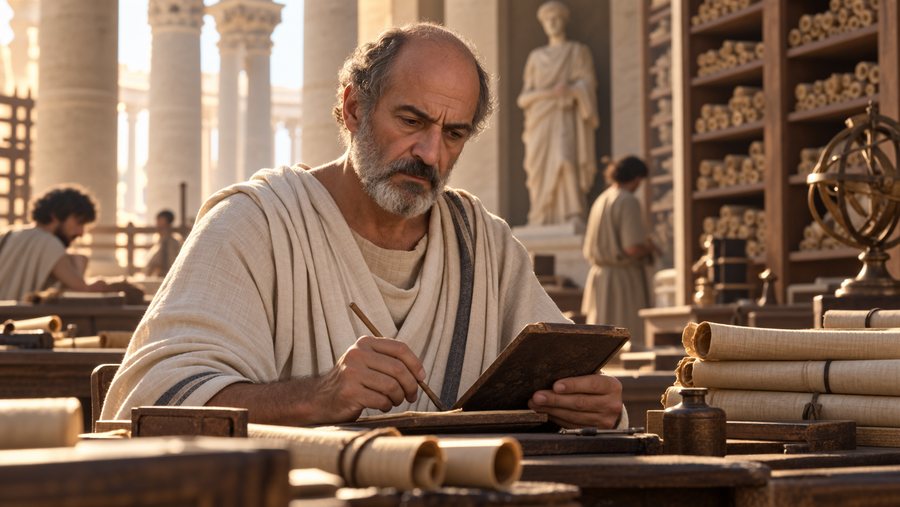
THE SCHOLAR
The Roman boy is idle, and Philo is curious, but neither of them has put a single basket back on the shelf.
PHILO
Ouch. That's a conjunction at work — a word that joins two ideas together, and here it joins them so that the second one can knock down the first.
Interjection
MARCOS
Oh! Fine — I'll put the baskets away.
SOPHIA
And there's the eighth and last, entirely by accident — a small burst of feeling, attached to nothing, standing outside the grammar of the sentence altogether. That's every job there is.
SOPHIA
Eight jobs, and a whole year to watch every word in this library step into one of them. We'll start with the verb that does more work than any other: be — the verb that doesn't describe an action at all, only how things are.